
Louisiana does not have concurrent jurisdiction between the state workers’ compensation scheme and federal workers’ compensation schemes. Louisiana Revised Statute 23:1035.2 provides that “[n]o compensation shall be payable in respect to the disability or death of an employee covered by the Federal Employer’s Liability Act, the Longshoremen’s (sic) and Harbor Worker’s Compensation Act, or any of its extensions, or the Jones Act.” If one of those acts apply, then the Louisiana Workers’ Compensation Act does not. In a new case, Johnson v. ACE American Insurance Company, Louisiana’s Fourth Circuit explored–albeit briefly–the lack of concurrent jurisdiction in Louisiana. The plaintiff sustained a work-related injury while aboard a boat that was involved in a collision on the Grand Pass. The injured worker filed claims under both the Louisiana Workers’ Compensation Act and the Longshore and Harbor Workers’ Compensation Act. At a hearing on exceptions filed by the defendants, the workers’ compensation judge (“WCJ”) determined that theRead more
Court Analyzes DBA, Exclusivity, and Borrowed Employee Rule

The Defense Base Act contains a provision which makes it an exclusive remedy. That means that a U.S. employee with a workplace injury (or their beneficiary) can only seek benefits from the employer pursuant to the DBA workers’ compensation scheme. The exclusive remedy provision states: The liability of an employer, contractor (or any subcontractor or subordinate subcontractor . . . ) under this Act shall be exclusive and in place of all other liability for such employer, contractor, subcontractor, or subordinate contractor to his employees (and their dependents) coming within the purview of this Act, under the workmen’s compensation law of any State, Territory, or other jurisdiction, irrespective of the place where the contract off hire of any such employee may have been made or entered into. See 42 U.S.C. § 1651(c). Recently, the United States District Court for the District of Arizona addressed the Defense Base Act’s exclusivity provision in the context of aRead more
Check Out the Interactive Constitution

Although this is a little off topic for the Longshore & DBA Review, I had to share a link to the Interactive Constitution: http://constitutioncenter.org/interactive-constitution. Have a question about an Article or Amendment? Then the Interactive Constitution might have the answer…and then some: On this site, constitutional experts interact with each other to explore the Constitution’s history and what it means today. For each provision of the Constitution, scholars of different perspectives discuss what they agree upon, and what they disagree about. These experts were selected with the guidance of leaders of two prominent constitutional law organizations–The American Constitution Society and The Federalist Society. This project is sponsored by a generous grant from the John Templeton Foundation. The Interactive Constitution is a work-in-progress. For instance, there is interactive content for Amendments 1-15, but content is in the works for other Amendments. Here’s a snippet of Gordon Wood’s write up of theRead more
New National Average Weekly Wage Numbers

Beginning on October 1, 2015, the following wage/compensation rates will apply in claims arising under the Longshore and Harbor Workers’ Compensation Act and its extensions. National Average Weekly Wage: $703.00 Maximum Compensation Rate: $1,406.00 Minimum Compensation Rate: $351.50 Percent Increase (from last year): 2.10% Visit the Division of Longshore and Harbor Workers’ Compensation’s NAWW Information Page for more information or to see past NAWW figures. Also, please keep in mind that the change in the National Average Weekly Wage applies to Defense Base Act claims too. Contact your attorney if you have any questions about the application of this change to your claim. Finally, if you need legal assistance with your Longshore or Defense Base Act claim, please contact Jon Robinson of Strongpoint Law Firm at (844) DBA-COMP or [email protected]. Attribution: Photo courtesy of Flickr User Ervins Strauhmanls.
The War Hazards Compensation Act: A Primer
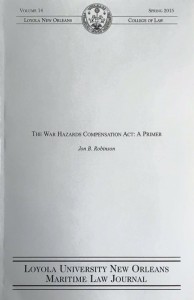
My new article is out. The Loyola Maritime Law Journal was nice enough to publish my piece, “The War Hazards Compensation Act: A Primer.” As soon as possible, I will update this post with a link to my SSRN page. There, you will be able to download a free copy of the article. In the meantime, here is the abstract: Over the past decade, the number of Defense Base Act and War Hazards Compensation Act claims dramatically increased. These two acts are inextricably intertwined when a “war-risk hazard” event causes an injured worker’s injury and disability. When that happens, an employer or its insurance carrier may use the War Hazards Compensation Act to secure reimbursement for Defense Base Act benefits and expenses paid on behalf of the worker’s injury and disability. Yet, little has been written to address the procedure for successfully maneuvering a claim from its Defense Base ActRead more
Non-Deployable Medical Conditions and the Defense Base Act

In most Defense Base Act cases the parties have to determine whether the injured worker can return to their usual and customary employment. For contractors, that means determining whether the injured worker can return to overseas employment. If they cannot return to their pre-injury job, then the injured worker is considered totally disabled until the employer demonstrates the existence of suitable alternative employment (i.e., another job that the claimant could work). But what if the injury suffered by the contractor–that is, the injury that required workers compensation in the first place–is best classified as a “non-deployable medical condition”? Today, I want to focus on non-deployable medical conditions and how those conditions could affect a Defense Base Act claim when the litigants are determining the injured worker’s post-injury employment outlook. Further, I want to address the situation where employers use overseas military contracting jobs on their labor market surveys to deflate anRead more
The Last Responsible Covered Employer Rule

When an injured employee worked for multiple employers, questions about liability can arise. If the employee’s multiple employers were all maritime or Defense Base Act employers, then the last responsible employer rule is applied. But, what happens when the employee worked for employers covered by the Longshore Act or DBA as well as non-covered employers? Last Responsible Employer or Last Responsible Covered Employer? In a Longshore and Harbor Workers’ Compensation Act claim, the last responsible employer rule assigns liability to the employer who last exposed the injured worker to injurious stimuli. The last employer in time is the first employer in liability. If the last employer can exculpate itself from liability, then the second most recent employer will be liable unless it can exculpate itself too. And so on. Most of the time, courts address the last responsible employer rule vis a vis multiple maritime employers. That is, a longshore workerRead more
No Defense Base Act Comp? Then No Report of Earnings.

Recently, I received a request that one of my clients complete the Report of Earnings, Form LS-200. This is a form developed by the Department of Labor’s Division of Longshore and Harbor Workers’ Compensation. The form itself is completely legit. But, in my case there was a problem. The employer and carrier were not paying compensation to my client. Consequently, the issue was whether my client may refuse to complete the requested form because the employer and carrier were not paying Defense Base Act benefits. Statutory Basis for the Report of Earnings: The Defense Base Act is an extension of the Longshore and Harbor Workers’ Compensation Act (“LHWCA”). Section 8(j) of the LHWCA contains the provision for reporting earnings. See 33 U.S.C. § 908(j). It states: (j)(1) The employer may inform a disabled employee of his obligation to report to the employer not less than semiannually any earnings from employment or self-employment,Read more
Increase Local National Comp Rates After Immigration?

Should the minimum compensation rate apply to foreign national Defense Base Act benefits recipients who become U.S. citizens or residents? In other words, should insurance carriers still pay Defense Base Act compensation rates tied to a foreign economy even though the injured worker is now living in a much more expensive country? The Defense Base Act is an extension of the Longshore and Harbor Workers’ Compensation Act. But there are some important differences. Whereas the Longshore Act uses a minimum compensation rate, the Defense Base Act does not. In fact, the Defense Base Act does not have a minimum compensation rate for disability or death benefits. Minimum Compensation Under the Longshore Act: First, let’s look at the Longshore Act. Injured longshore workers who are totally disabled are paid wages equal to two-thirds of their average weekly wage. But, there is a floor. The statutory basis for the minimum compensation rateRead more
In Memoriam: Jordan Guzzino McFaull

This week, the maritime legal community lost one of its rising stars. Jordan Guzzino McFaull passed away in New Orleans, Louisiana at the age of 26. I met Jordan through the Loyola Current, which is a student run maritime blog from the Loyola University New Orleans College of Law. It is safe to say that the Loyola Current took shape and found its sea legs under Jordan’s direction. His accomplishment is no small feat considering that Jordan juggled the Loyola Current with the Loyola Maritime Law Journal, 3L classes, and working at the Coast Guard. After law school, Jordan joined my old firm. Respected colleagues praised his character and work ethic. The praise was well-deserved. Jordan impressed me with his kind demeanor, tenacity, and skill as an attorney. A memorial will be held for Jordan in Lake Charles, LA on August 15th from 2 p.m. until 4 p.m. at theRead more
- « Previous Page
- 1
- …
- 11
- 12
- 13
- 14
- 15
- …
- 39
- Next Page »