
A new Defense Base Act / Longshore decision from the U.S. Court of Appeals for the District of Columbia discusses penalties available to contractors injured overseas. Importantly, the decision also addresses the remedies that are not available to aggrieved contractors and longshore workers. The decision is Brink v. Continental Insurance Company. To start with, I am going to quote from the court’s syllabus, but keep reading: Appellant Daniel Brink, joined by thirty-one other individuals, brought a class action lawsuit stemming from the workers’ compensation benefits owed to class members under the Defense Base Act, 42 U.S.C. § 1651 et seq., for injuries suffered while working for United States government contractors in Iraq and Afghanistan. In connection with their Base Act claims, appellants alleged that several government contractors, insurance companies, and third parties (collectively “contractors”) committed torts and violated the Longshore and Harbor Workers’ Compensation Act, the Racketeer Influenced and CorruptRead more
How to Classify Longshore Disability Benefits

The Fourth Circuit issued a new Longshore and Harbor Workers Compensation Act decision discussing the various types of disability benefits paid under the Act. The new case is Huntington Ingalls Industries, Inc. v. Eason, and it is sure to garner a lot of attention for a fairly routine knee injury claim. Explaining the Longshore Act and Disability: Disability is an economic concept. An injured worker’s disability is not measured solely by the severity or duration of their medical condition. Instead, the effect on an injured worker’s wage-earning capacity must be considered, too. There are four types of Longshore indemnity benefits: temporary total, temporary partial, permanent total, and permanent partial benefits. The difference between temporary and permanent disability is whether the injured worker has reached maximum medical improvement (i.e., medical permanency). And, the difference between total and partial disability is whether the injured worker can return to their pre-injury job, orRead more
New Burn Pit Legislation Proposed

There is a new burn pit bill at the House of Representatives called the “Helping Veterans Exposed to Burn Pits Act.” Congresswoman Elizabeth Esty introduced the bill for herself and for Congressman Jim McDermott. Congresswoman Esty’s press release details some of the concerns that led to her introduction of the bill: Military personnel serving in Iraq and Afghanistan are exposed to a variety of potentially harmful substances including the smoke produced from the burning of waste on military bases. Items such as plastics, aerosol cans, electronic equipment, human waste, metal containers, tires, and batteries are thrown into open pits, sometimes doused with jet fuel, and set ablaze. Smoke from these open-air burn pits can waft throughout the entire base and even into living areas. Health effects from exposure to chemicals found in burn pits can include cancer, neurological and reproductive effects, respiratory toxicity, and cardiovascular toxicity. Compelling concerns, right? Near-termRead more
New Rules for Longshore and Defense Base Act Hearings

Get ready for some significant changes to the litigation of Longshore and Defense Base Act claims. The new Rules of Practice and Procedure for Administrative Hearings Before the Office of Administrative Law Judges will become effective in the immediate future. As such, practitioners, parties, and even experts who testify in Longshore and DBA claims should review the new rules. This link will take you to the Final Rule published in the Federal Register. There are a lot of changes. It is clear that the Department of Labor had one thing in mind when instituting the changes: protection of the integrity of the adjudication process. The rub is that some of the rules may very well result in increased litigation costs and hardships for Longshore and DBA litigants. Perhaps the easiest way to talk about the changes instituted in the new Rules is to talk about categories of changes as opposedRead more
“Delayed Expression” PTSD: Statute of Limitations Kryptonite?

The Longshore and Defense Base Act statute of limitations has a lot of power–like the power to nullify an injured worker’s indemnity benefits claim. But the statute of limitations is not invulnerable. In this post, I am going to talk about a qualifier attached to some Post Traumatic Stress Disorder diagnoses–“delayed expression”–and how that qualifier could affect the Longshore and Defense Base Act statute of limitations. “Delayed Expression” Post Traumatic Stress Disorder: Mental health professionals use the American Psychiatric Association’s Diagnostic and Statistical Manual of Mental Disorders to diagnose mental disorders. The most recent version, called the DSM-5, is a one-stop shop for the criteria needed for a Post Traumatic Stress Disorder diagnosis. In addition to a basic list of diagnostic criteria, the DSM-5 has a section entitled, “Development and Course,” which discusses the length of time that it may take for PTSD to develop. Specifically, the DSM-5 says: PTSDRead more
How Long Will a Contractor’s PTSD Last?

Contractors experiencing PTSD likely have problems with anger, anxiety, depression, forgetfulness, frustration, sleeplessness, stress, and withdrawal. They are likely asking themselves how long these symptoms are going to last. To answer this question and consider the legal effect of long lasting disability, contractors must consider the Diagnostic and Statistical Manual of Mental Disorders and the Defense Base Act. The Diagnostic and Statistical Manual of Mental Disorders: The “go-to” manual for the diagnosis of mental disorders is the American Psychiatric Association’s DSM-5. Essentially, think of the DSM-5 as a one-stop shop for the basic criteria necessary for a PTSD diagnosis. But the DSM-5 contains more than a basic list of diagnostic criteria. It also contains a section entitled, “Development and Course,” which discusses the length of time that it may take for PTSD to develop, as well as the length of time that PTSD may last. As for the time itRead more
New Article At Lexis Re: Medical Evidence in Longshore Claims

I follow LexisNexis’s Workers’ Compensation Law Community and check in often. A couple of weeks ago, Lexis posted an article from Yelena Zaslavskaya, the senior attorney for the Office of Administrative Law Judges. The article, entitled “Evaluation and Weighing of Medical Opinion Evidence in Longshore Cases,” discusses the medical evidence that is often presented in Longshore and Defense Base Act claims. Further, the article discusses how judges evaluate the medical evidence, especially where there are conflicting reports. I don’t want to steal any thunder from the LexisNexis article. As such, I encourage you to click on the hyperlinks above and check out the article for yourself. Photo courtesy of Flickr user Chris Potter.
Local National Translators and Defense Base Act Benefits

What if helping your home country also meant leaving your home country…at gun point…or to escape a price on your head? Some of our military contractors are faced with that very question. Specifically, I am talking about local nationals who help the United States or its allies in the war on terror. One of the most important jobs in the military involves translation and interpretation, a job that often requires the use of private contractors. Some interpreters are embedded with military units, going outside-the-wire with their team for extended periods of time. Others work from a forward operating base, translating intercepted broadcasts from insurgents. To be sure, there are translators and linguists from the United States that work in Afghanistan and Iraq. But local nationals are also hired to fill these roles. The Most Dangerous Job for Local National Contractors? It is hard to determine which job is the mostRead more
Just For Fun: Strongpoint Law Firm Playing Cards
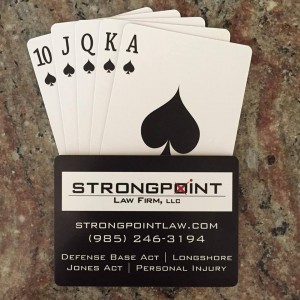
What client gift is best suited for Strongpoint Law Firm? A pen? A paperweight? How about playing cards? I just received Strongpoint Law Firm’s first batch of playing cards. And as you can likely tell, I am flush with joy over the finished product. (I’ll stop with the bad puns now.) In all seriousness, I am lucky to have great clients–folks that become family over the course of their claim. If the new playing cards make my clients happy, then the cards make me happy, too. As you can tell from the picture, Strongpoint Law Firm represents injured workers and their families in claims arising under the Defense Base Act, the Longshore and Harbor Workers’ Compensation Act, the Jones Act, and in personal injury matters. If Strongpoint Law can help you, contact me (Jon Robinson) immediately. I can be reached by phone at (985) 246-3194, by e-mail at [email protected], orRead more
Service Animal Coverage for Longshore and DBA Claims

Are service animals covered by the Longshore Act and the Defense Base Act as “medical benefits”? If so, what types of service animals are covered? Medical Benefits: To begin to answer the service animal questions, let’s look at Section 7 of the Longshore Act. Section 7 defines an employer’s obligation to pay medical benefits. Pursuant to that statute, the “employer shall furnish such medical, surgical, and other attendance or treatment, nurse and hospital service, medicine, crutches, and apparatus, for such period as the nature of the injury or the process of recovery may require.” See 33 U.S.C. § 907 (emphasis added). For the cost of the medical treatment to be assessed against the employer or its insurance carrier, the medical expense corresponding to the work-related injury must be both reasonable and necessary. That is the general framework for medical treatment. Employers shall provide treatment, but only treatment that is medicallyRead more
- « Previous Page
- 1
- …
- 9
- 10
- 11
- 12
- 13
- …
- 23
- Next Page »