 In Defense Base Act claims, injured workers file claims against their employer. The employer is a party to the litigation. The employer’s DBA insurance carrier merely stands in employer’s shoes for liability purposes. The insurance carrier assigns a lawyer to defend the employer. The employer is the lawyer’s client.
Yet, during DBA litigation, the attorney assigned by the insurance carrier rarely interacts with the employer. Instead, the carrier-assigned attorney answers the written discovery requests propounded by claimant without actually interacting with the employer.
Not only does this practice violate the Rules of Practice and Procedure for Administrative Hearings Before the OALJ, it deprives the DBA claimant of relevant evidence that the claimant may want to use to corroborate their injury claim.
So, what’s the answer? In most cases, the claimant must depose an employer representative. That is the only way to get answers from the employer to claim-related questions.
The Discovery Process in DBA Claims
The necessary parties to a DBA claim include the claimant and employer. A carrier may appear in the litigation for liability purposes. See 33 U.S.C. § 935. The carrier does not appear to provide factual information about the claimant’s employment Id.
During the DBA litigation, the parties serve written discovery requests on each other. Written discovery includes interrogatories, requests for production of documents, and requests for admission. Specific rules govern each form of written discovery. See 29 C.F.R. §§ 18.60 (interrogatories), 18.61 (requests for production of documents, and 18.63 (requests for admission).
Quite simply:
- Interrogatories are questions. Answers to interrogatories must be verified by a party.
- Requests for production of documents are exactly what they sound like: requests for documents in a party’s possession, custody, or control.
- Requests for admissions, which are factual admissions the party may admit or deny in whole or in part.
In addition to written discovery, the parties may depose one another and anyone else with factual information. Special rules exist for depositions by oral examination of business organizations–like employers. Essentially, the party noticing the deposition of an organization must “describe with reasonable particularity the matters for examination.” See 29 C.F.R. § 18.64(b)(6). Then, the organization is supposed to identify a person or persons it designates to testify on the organization’s behalf. Id. The testifying individual “must testify about information known or reasonably available to the organization.” Id.
Complete Breakdown in the Discovery Process
The DBA practice area has reached the point of breakdown in the discovery process. When an attorney fails to communicate with their client, the party cannot legitimately participate in the mandatory discovery process. Yet, recent depositions make clear that attorneys hired by insurance carriers to represent employers are not actually speaking to the employer during the discovery process.
Here’s an example. The claimant served written discovery requests on the employer and carrier. When the claimant received the employer and carrier’s responses, he noticed that only the DBA defense attorneys responded to the discovery. In other words, carrier-assigned DBA attorneys with limited knowledge of the employer’s business and without any kind of contract with employer conferring general agency rights to the DBA attorneys answered the claimant’s discovery requests as if they were the employer.
So, the claimant requested and noticed an employer representative deposition. The employer then filed a motion to quash the employer representative deposition to prevent it from happening. In the motion, the carrier-assigned attorneys argued that Employer/Carrier’s written discovery answers and responses adequately addressed the topics identified for the representative deposition. But, remember, only the carrier-assigned DBA attorneys answered discovery.
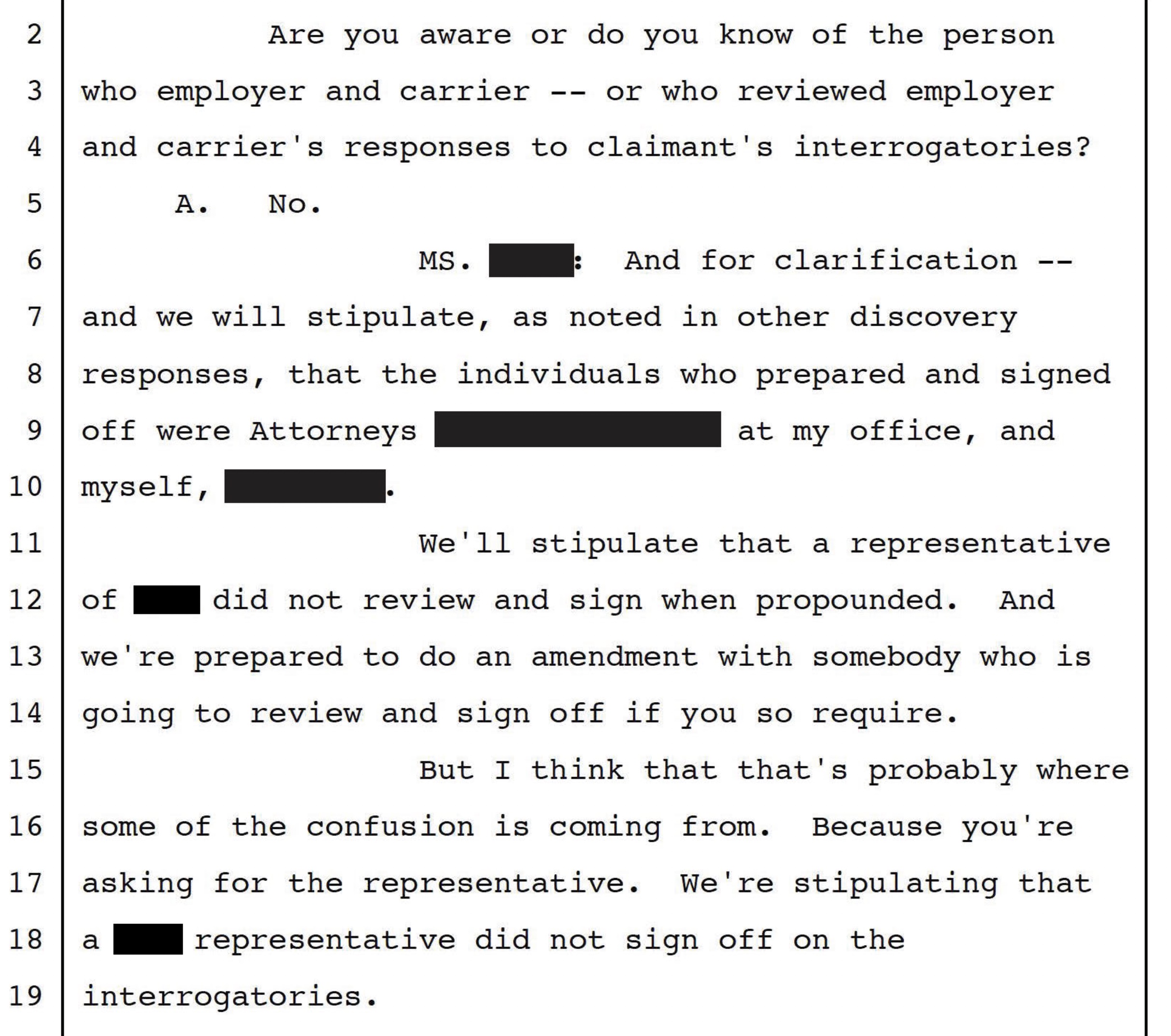
After the administrative law judge denied the motion to quash, the employer representative deposition moved forward. Then, at the deposition, the carrier-assigned DBA attorney interrupted testimony to stipulate that no one from the employer’s business ever reviewed the claimant’s discovery requests.
The carrier-supplied DBA attorney had this to say about Employer/Carrier’s written interrogatory answers:
Further, the carrier-assigned DBA attorney stipulated about the noninvolvement of an employer representative with the responses to requests for production:
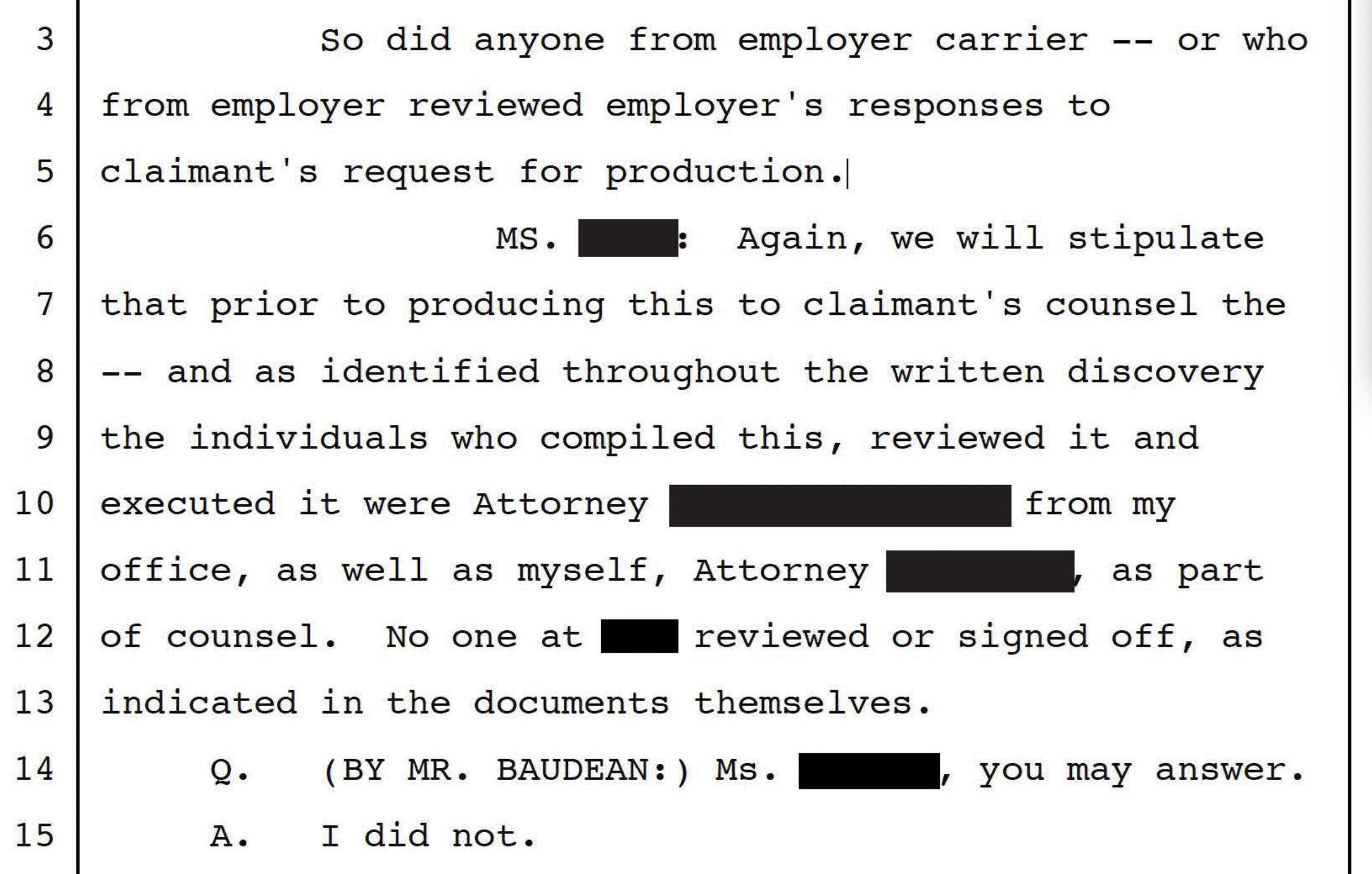
Just to briefly recap this chain of events. First, the carrier-assigned DBA attorneys answered discovery propounded on the employer and carrier without conferring with the employer. Second, the carrier-assigned DBA attorneys filed a motion to quash an employer representative deposition with the OALJ even though they knew the employer never participated in the written discovery process. Third, after the assigned ALJ had to spend precious judicial resources to overrule the motion to quash, the carrier-assigned DBA attorneys stipulated at the deposition that an employer representative never even reviewed the answers to interrogatories or responses to requests for production of documents.
That is a breakdown in the discovery process. And it’s not a small breakdown. It strikes at the core bargain of the Defense Base Act system. Worse still, the breakdown happens over and over again–case after case, claim after claim.
Why This Matters
Discovery only works if the parties participate. The OALJ rules require that interrogatory answers be verified by a party and that document responses be made after a reasonable inquiry. When carrier-assigned counsel answers on the employer’s behalf without consulting the employer, the employer isn’t participating in discovery at all. The carrier is essentially manufacturing a proxy record through lawyers who don’t actually have the facts.
That has two predictable consequences:
-
The record becomes distorted. Claimants are forced to litigate against “paper answers” that no one with firsthand knowledge stands behind.
-
Claimants incur extra cost to get basic facts. Instead of learning who supervised the work, what safety procedures existed, or what the job really required through written discovery, they have to spend time and money noticing and taking 30(b)(6)-style depositions of employer representatives.
Discovery is not supposed to be a scavenger hunt where one side hides the ball and the other side pays to find it.
Carriers Don’t Get to Replace the Employer as a Fact Witness
Yes, carriers may appear for liability purposes. But a carrier’s lawyer is not a fact witness for the employer. The carrier cannot “answer around” the employer’s knowledge. It can’t file discovery responses that appear to be compliant on paper while quietly skipping the required step of speaking to the client.
The procedural rules aren’t technicalities. They exist to ensure that testimony and evidence come from the people who actually know what happened. When employers are cut out of their own case, the process loses legitimacy.
One additional problem with carrier-drafted interrogatory responses is that they don’t actually bind the employer in any meaningful way. Interrogatories are designed to lock a party into a verified factual position so the opposing side can rely on those admissions in preparing the case and at hearing. But if the employer never reviewed, approved, or verified the answers—if they were generated solely by carrier-assigned counsel—then the “party” hasn’t adopted the statements, and the claimant is left with responses that are functionally unmoored from the employer’s knowledge. That creates a fairness gap: the defense gets to wield interrogatory answers as if they are the employer’s positions, while the claimant can’t confidently use them as true party admissions for impeachment or corroboration.
The only way to restore the interrogatories to their intended role is to require employer verification or, failing that, treat the answers as counsel argument rather than binding employer testimony—making a representative deposition not just helpful, but essential to establish what the employer will actually stand behind.
The Practical Fix: Make the Employer Show Up
Until this practice changes, claimants need to plan discovery accordingly:
-
Notice a representative deposition. If written discovery comes back signed only by counsel with no employer involvement, that’s your signal.
-
Draft topics with precision. Describe the matters for examination clearly and narrowly so the employer can’t credibly argue the deposition is a fishing expedition.
-
Be ready to oppose motions to quash. If the only “facts” the employer offers are lawyer-authored interrogatory answers, that is not a substitute for testimony from a designated representative.
In short: if the employer didn’t review and verify the answers, the employer has not answered. A deposition is not duplicative—it’s necessary.
What ALJs Can Do to Stop the Bleeding
Administrative law judges shouldn’t have to babysit basic discovery compliance. But when this issue is teed up, ALJs have tools:
-
Remind parties in the prehearing order that the Court requires party-verified responses. Do not accept a verification signed by the carrier-supplied Defense Base Act attorneys. They aren’t in-house counsel.
-
Allow representative depositions as a matter of course where the employer has not participated in preparing a response.
-
Impose sanctions when motions to quash are filed to conceal the noninvolvement of the employer.
-
Require counsel to certify that the employer reviewed and approved written responses.
Judicial resources are too scarce to burn on avoidable gamesmanship.
Bottom Line
In a DBA case, the employer is a party. Parties must participate in discovery. When carrier-assigned attorneys answer for an employer without consulting that employer, the process fails—and claimants are forced to fix it in this extraordinarily expensive way.
Until the parties or the judges fix this breakdown, claimants should treat written discovery as incomplete unless it’s backed by real employer involvement—and should not hesitate to take the deposition that the rules already contemplate.
Because discovery isn’t optional. And neither is the truth.