
Before a claimant gets their money, the Department of Labor must approve the claimant’s Longshore or Defense Base Act settlement. It’s a legal requirement. A claimant will not receive any of the settlement proceeds until the DOL reads and approves the settlement. Essentially, the DOL wants the last say regarding monetary adequacy of the settlement. Recently, the DOL issued OWCP Bulletin No. 14-05. In it, the DOL addressed Section 8(i) of the Longshore and Harbor Workers’ Compensation Act—the Act’s settlement provision—in light of an important decision from the Benefits Review Board, Richardson v. Huntington Ingalls, Inc. Richardson Addresses the Determination of Settlement Adequacy: Here’s a quick history lesson about Richardson. In 2013, a represented claimant and a represented employer got together and negotiated a settlement. They submitted the settlement to the district director for approval, but the district director denied the settlement. He determined that, under the guidelines he wasRead more
Welcome to Strongpoint’s New Website

Hello! My name is Jon Robinson. Thank you for visiting Strongpoint Law Firm. You have arrived just in time for the grand unveiling of the firm’s website and blog, the Longshore & DBA Review. Exciting times, indeed! Hopefully you found this website because you are interested in what I do, what I know, and how I can change your life for the better. So, let me boil down what I do: I help injured people. Plain and simple. Strongpoint Law Firm is not a general practice law firm. I am not litigating claims against insurance companies one day and then writing wills the next. My preference is to practice in four areas of law: Defense Base Act Longshore and Harbor Workers’ Compensation Act Maritime injuries, including Jones Act claims Personal injuries By practicing in specific areas of law, my skills are honed to maximize your recovery. Make no mistake, youRead more
Don’t Amend the Defense Base Act with H.R. 312
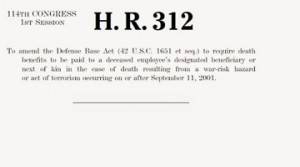
Last month, Representative Stephen Lynch reintroduced a proposed amendment to the Defense Base Act (H.R. 312). This is a re-introduction of an amendment (H.R. 5721) he proposed in late 2014 to “remove a significant penalty in federal law that currently prohibits the families of overseas federal contractors who are killed in the line of duty from receiving full death benefits if the deceased employee is unmarried with no children or other dependents.” Ultimately, Rep. Lynch’s amendment appears destined to fail. The Reason for H.R. 5721, and now H.R. 312: Representative Lynch proposed H.R. 5721, the Overseas Security Personnel Fairness Act, to address an issue that arose from the September 2012 terrorist attack on the U.S. Consulate in Benghazi, Libya. Glen Doherty, a security contractor and former Navy SEAL, was killed during the attack. He was unmarried, with neither children nor other dependents. Yet, he had activated a mandatory Defense Base Act insurance policy before deploying toRead more
Insider Attacks Cause Compensable Defense Base Act Claims

News surfaced this past weekend about an insider attack at Kabul’s military airport that left three contractors dead. According to news sources, the three contractors—all American—worked as aircraft mechanics for Praetorian Standard, a company headquartered in Fayetteville, NC. News sources, and Praetorian, released the names of the contractors, Matthew E. Fineran, Walter D. Fisher, and Jason D. Landphair. Our thoughts and prayers are with their families and loved ones, as they are with Bradley James, who was injured in the small arms fire attack. Insider attacks, also referred to as “green-on-blue” attacks, are somewhat common occurrences in Afghanistan. In many situations, these events can lead to compensable Defense Base Act claims. The Defense Base Act Is Workers’ Compensation. The Defense Base Act is a system of federal workers’ compensation. Generally, the DBA covers defense contractors working outside of the United States under government contracts or on U.S. military bases. IfRead more
Is Erik Prince Right? Should We Fight ISIS with Defense Contractors?
Is Erik Prince, the ex-Blackwater CEO, right? Should the United States use Defense Base Act contractors to fight ISIS? On his blog for Frontier Services Group, Mr. Prince wrote a post entitled, “Chairman’s Column – Thoughts on Countering ISIS,” which I’ve reproduced in full below: As someone who spent many years operating in Iraq, Afghanistan, and other underdeveloped countries facing existential security threats, I was recently asked about my reaction to President Obama’s plan for fighting ISIS. My immediate response is that the President’s current plan seems half-hearted at best. American air power has significant reach and accuracy, but ultimately will be unable to finish the job of digging ISIS out of any urban centers where they may seek shelter amongst the populace. Clearing operations ultimately fall to the foot soldier. The Iraqi army is demonstrably inept after billions spent on training and equipping them. Providing them more gear isRead more
Doctors Were Not Entitled to Intervene in Defense Base Act Case at the OALJ
Claimant was injured while working as a linguist in Iraq. His claim was referred to the Office of Administrative Law Judges (“OALJ”) for adjudication, in part because of a medical payment dispute. Employer paid some of the medical bills in question after it received itemized statements. Believing that the disputed medical payment issue was resolved, Claimant and Employer/Carrier submitted Stipulations which outlined Claimant’s injury, medical treatment, entitlement to benefits, and Claimant’s responsibility to provide itemized invoices and statements for medical expenses. The Administrative Law Judge (“ALJ”) then remanded the claim to the district director at the Division of Longshore and Harbor Workers’ Compensation. While the parties were resolving their issues, but before the ALJ remanded the claim, two doctors attempted to intervene in the Defense Base Act litigation. The doctors alleged that they had not been paid for their treatment of Claimant’s work injuries. After the ALJ remanded the claim,Read more
Benefits Review Board Accepts Electronic Filings
This following notice is posted on the Benefits Review Board’s home page. Notice Regarding Availability of Electronic Filing and Electronic Service All parties to appeals before the Benefits Review Board (BRB) may now use the Board’s Electronic File and Service Request (EFSR) system. The EFSR portal allows parties to file new appeals electronically, receive electronic service of Board issuances, file briefs and motions electronically, and check the status of existing appeals via a web-based interface accessible 24 hours every day in lieu of paper documents. The EFSR system is open to any party to an appeal before the Board. An e-Filer must register as a use and must be validated by the Board before e-filing any document. An e-Filer will complete an online registration form. A valid e-mail address is required to register as an e-Filer. Once registered, an e-Filer will be able to use the EFSR for electronic filingRead more
DOL Issued 2014-15 National Average Weekly Wage Increase for Longshore Claims
On October 1, 2014, the National Average Weekly Wage applicable to Longshore claims (including Longshore extensions like the Defense Base Act) will increase pursuant to Section 10 of the Longshore and Harbor Workers’ Compensation Act. The new compensation rates are: National Average Weekly Wage: $688.51 Maximum Compensation: $1,377.02 Minimum Compensation: $344.26 Percentage Increase: 2.25% (Note: I first published this post on Navigable Waters: A Maritime, Longshore and Defense Base Act Blog.)
Do You Need a Medicare Set Aside for Your Longshore or Defense Base Act Settlement?
In every case where a Longshore worker or Defense Base Act contractor agrees to close or limit their right to future medical benefits, the parties must consider whether a Medicare Set Aside is needed. What is a Medicare Set Aside and why is it needed? Essentially, the Centers for Medicare and Medicaid Services (“CMS”) does not want to pay for workers’ compensation injuries. The Medicare Secondary Payer laws protect CMS from workers’ compensation litigants who may want to shift the liability for payment of future medical benefits to CMS. Consequently, in certain situations, the parties to a workers’ compensation settlement must prepare “a financial agreement that allocates a portion of a workers’ compensation settlement to pay for future medical services related to the workers’ compensation injury, illness or disease. These funds must be depleted before Medicare will pay for treatment related to the [injury].” Moreover, CMS will want proof (inRead more
The Zone of Special Danger Includes Grocery Shopping
In a new published Defense Base Act (“DBA”) claim, the Benefits Review Board further clarified the zone of special danger doctrine. A widow filed a claim for death benefits after her husband was killed in Tbilisi, Georgia, while working for the employer. The decedent’s job required that he work five days per week, and that he remain on-call for emergencies. In addition to wages, the decedent received a monthly allotment for housing and utilities, as well as vouchers for a taxi service. While riding in a taxi going to the grocery store, the decedent’s vehicle was struck head-on by another car, causing his death. Death benefits are owed under the Longshore and Harbor Workers’ Compensation Act, as extended by the DBA, when the decedent died in the “course of employment.” For Defense Base Act claims, the Supreme Court has held the “an employee may be within the course of employment,Read more
- « Previous Page
- 1
- …
- 11
- 12
- 13
- 14
- 15
- …
- 23
- Next Page »