Today the Ninth Circuit Court of Appeals heard oral arguments in Chugach Management Services v. Jetnil. I have previously discussed the zone of special danger aspect of Jetnil, as well as the briefs submitted by the parties. Below is a video of today’s argument. It is worth watching if you are interested in this area of the law. The carrier’s attorney argues first, followed by the claimant’s attorney, and then the government’s attorney. I don’t think the importance of the case can be overstated. Do we want to exclude an entire class of workers (local nationals) from the applicability of the zone of special danger? What if a local national (typically just a person from the country in which they work) is employed on the other side of the country and not near their home? I’ll have more of an analysis after I get to digest the argument a littleRead more
Maybe It’s Time To Contact Congress About Your Defense Base Act Claim

Back in 2008, the Defense Base Act industry found itself in the cross-hairs of Congressional scrutiny. Insurance companies were denying legitimate claims. Some of the claims that were paid were done so after a lengthy delay. Some injuries, like PTSD, were viewed with skepticism. All the while, insurance companies were making huge profits off of the war. Like many industries that come under fire, the DBA industry tried to correct itself. The Department of Labor developed a tracking system to determine when claims were reported, and when claims were paid. Anyone can log onto the DOL’s website and view the DBA industry report cards. The report cards do not, however, provide the full story, especially with PTSD. For a while, DBA administration issues became fewer and farther between. Many claims were paid. It looked like the industry would normalize. Unfortunately, the honeymoon was short-lived. In my opinion, we are backRead more
Happy Thanksgiving!

This has been a great year. Strongpoint Law Firm has thrived because of the help and support of family, friends (new and old), and colleagues. Thank you. Happy Thanksgiving! And for the history buffs out there, here is the proclamation issued by President Abraham Lincoln on October 3, 1863, which set the precedent for America’s national day of Thanksgiving: The year that is drawing towards its close, has been filled with the blessings of fruitful fields and healthful skies. To these bounties, which are so constantly enjoyed that we are prone to forget the source from which they come, others have been added, which are of so extraordinary a nature, that they cannot fail to penetrate and soften even the heart which is habitually insensible to the ever watchful providence of Almighty God. In the midst of a civil war of unequaled magnitude and severity, which has sometimes seemed toRead more
In Memoriam: Jordan Guzzino McFaull
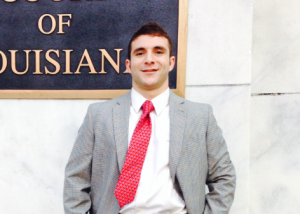
This week, the maritime legal community lost one of its rising stars. Jordan Guzzino McFaull passed away in New Orleans, Louisiana at the age of 26. I met Jordan through the Loyola Current, which is a student run maritime blog from the Loyola University New Orleans College of Law. It is safe to say that the Loyola Current took shape and found its sea legs under Jordan’s direction. His accomplishment is no small feat considering that Jordan juggled the Loyola Current with the Loyola Maritime Law Journal, 3L classes, and working at the Coast Guard. After law school, Jordan joined my old firm. Respected colleagues praised his character and work ethic. The praise was well-deserved. Jordan impressed me with his kind demeanor, tenacity, and skill as an attorney. A memorial will be held for Jordan in Lake Charles, LA on August 15th from 2 p.m. until 4 p.m. at theRead more
Insider Attacks Cause Compensable Defense Base Act Claims

News surfaced this past weekend about an insider attack at Kabul’s military airport that left three contractors dead. According to news sources, the three contractors—all American—worked as aircraft mechanics for Praetorian Standard, a company headquartered in Fayetteville, NC. News sources, and Praetorian, released the names of the contractors, Matthew E. Fineran, Walter D. Fisher, and Jason D. Landphair. Our thoughts and prayers are with their families and loved ones, as they are with Bradley James, who was injured in the small arms fire attack. Insider attacks, also referred to as “green-on-blue” attacks, are somewhat common occurrences in Afghanistan. In many situations, these events can lead to compensable Defense Base Act claims. The Defense Base Act Is Workers’ Compensation. The Defense Base Act is a system of federal workers’ compensation. Generally, the DBA covers defense contractors working outside of the United States under government contracts or on U.S. military bases. IfRead more
Is Sarbanes-Oxley Really This Fishy?
Next week the Supreme Court will hear arguments in Yates v. United States, a Sarbanes-Oxley anti-shredding case. The Sarbanes-Oxley Act was enacted after the Enron scandal. One of the provisions of the Act is commonly known as the “anti-shredding provision,” which criminalizes knowingly altering, destroying, mutilating, concealing, covering up, falsifying, or making a false entry in “any record, document, or tangible object with the intent to impede, obstruct, or influence the investigation or proper administration” of any federal matter. Why am I mentioning Sarbanes-Oxley on a maritime blog? Because Yates v. United States involves the federal government’s application of the “anti-shredding provision” to a commercial fisherman who directed his crewmen to throw undersized fish back into the sea, after receiving a civil citation and being told to bring the fish to dock to be destroyed. That’s right…throwing fish back into the sea landed one fisherman in the Sarbanes-Oxley anti-shredding net. Read more
More Briefs Filed in Dize v. Association of Maryland Pilots
In 1995, the Supreme Court decided Chandris, Inc. v. Latsis, 515 U.S. 347 (1995), wherein it announced a test for determining “seaman” status. To qualify as a “seaman” the employee must (1) contribute to the function of a vessel or to the accomplishment of its mission, and (2) have a connection to a vessel in navigation that is substantial in both duration and nature. The Supreme Court favorably cited a rule of thumb from the Fifth Circuit whereby an employee would be denied “seaman” status if they spent less than 30% of their time in the service of a vessel in navigation. Last year, the Court of Appeals of Maryland decided Dize v. Association of Maryland Pilots, which addressed the “seaman” status of an employee who maintained vessels that are dockside or ashore. The court determined that such work does not factor into the 30% rule because maintaining a mooredRead more
No Work-Related Stress Claims Under the Jones Act, Says 11th Circuit
William Skye worked a lot. A whole lot. Skye worked between 90 and 105 hours per week for 70 to 84 days at a time. Over the course of eight years, Skye’s cardiac condition (initially a benign arrhythmia) worsened. Skye’s cardiologist concluded that Skye’s “continued physical stress related to his job, with long hours and lack of sleep” caused the worsening. By 2008, Skye was diagnosed with left ventricular hypertrophy–a thickening of the heart wall of the left ventricle. According to the cardiologist, Skye’s stress led to hypertension which, in turn, caused the left ventricular hypertrophy. In 2011, Skye sued Maersk Line for negligence under the Jones Act. He alleged that Maersk failed to provide reasonable working hours, an adequate crew, and adequate rest. Maersk overworked him to the point of fatigue, thus causing physical damage to his heart. A jury agreed and awarded damages of $2,362,299. But because SkyeRead more
Around the Longshore and Maritime Blogosphere
Happy Friday, everyone. Here are some great Longshore and maritime related posts that I recommend reading. The LexisNexis Workers’ Compensation Law Community published two interesting articles. First up is Karen Koenig’s Update from the Benefits Review Board (May 2014). In addition to important statistics about the Board’s caseload, the article addresses the Board’s recent interpretation of Section 2(3)(F) of the Longshore and Harbor Workers’ Compensation Act (“LHWCA”). Congress amended Section 2(3)(F) in 2009. It now excludes from coverage “individuals employed to build any recreational vessel under sixty-five feet in length, or individuals employed to repair any recreational vessels, or to dismantle any part of a recreational vessel in connection with the repair of such vessel . . . if [the individual is] subject to coverage under a state workers’ compensation law.” Next up is The Loyola Current, which is published by the Loyola New Orleans Maritime Law Journal. Recent postsRead more
What is the Scope of a War Hazards Compensation Act Appeal?
When an insurance carrier believes that it was improperly denied reimbursement for a War Hazards Compensation Act (“WHCA”) claim or expense, what can it do? It can appeal…but not to a court. The appeal is “in-house” at the Division of Federal Employees Compensation (“DFEC”). Essentially, the higher-ups in the same agency that denied the initial request for reimbursement will review the evidence and determine whether the denial was appropriate. The regulatory authority for a WHCA appeal is at 20 C.F.R. § 61.102(d), which states: The Office shall advise the carrier of the amount approved for reimbursement. If the reimbursement request has been denied in whole or in part, the Office shall provide the carrier an explanation of the action taken and the reasons for the action. A carrier within the United States may file objections with the Associate Director for Federal Employees’ Compensation to the disallowance or reduction of aRead more