
Too few Defense of Freedom Medals are awarded to deserving contractors. Far too few. When a civilian or military contractor is killed or wounded by hostile action experienced in the line of duty, then the contractor may be awarded the Secretary of Defense Medal for the Defense of Freedom–commonly known as the Defense of Freedom Medal or DFM. Initially, the medal was created for certain victims of the September 11th attack. Since that time, the scope of the medal has been extended to additional employees, including defense contractors. The problem, in my opinion, is that the medal is not awarded frequently enough. I base my opinion on the number of War Hazards Compensation Act claims opened and processed by the Department of Labor over the last decade in comparison to the few Defense of Freedom medals awarded during the same period of time. What are the Medal’s Requirements? Department ofRead more
Acute Stress Disorder and the Defense Base Act

PTSD is not the only psychological disorder affecting civilian contractors employed overseas. Other psychological disorders are equally dangerous, and they are also covered by the Defense Base Act. Over the next couple of months, I am going to periodically provide the diagnostic criteria for other mental disorders that are common to DBA claims. These criteria come directly from the American Psychiatric Association’s Diagnostic and Statistical Manual of Mental Disorders (also known as the DSM-5). And all of the disorders that I will mention are disorders I have actually encountered in Defense Base Act and War Hazards Compensation Act claims. Today’s post is about Acute Stress Disorder, the diagnostic criteria of which is: A. Exposure to actual or threatened death, serious injury, or sexual violation in one (or more) of the following ways: 1. Directly experiencing the traumatic event(s) 2. Witnessing, in person, the event(s) as it occurred to others. 3. LearningRead more
Grocery Shopping and the DBA’s Zone of Special Danger

Does the Defense Base Act’s zone of special danger doctrine extend to grocery shopping? That is a question the First Circuit will have to answer in Battelle Memorial Institute v. DiCecca, where a civilian contractor was killed while traveling in an employer-provided taxi to a grocery store in Tbilisi, Georgia. Grocery Shopping Falls Within the Zone of Special Danger? The First Circuit appeal stems from a Benefits Review Board Decision and Order in DiCecca v. Battelle Memorial Institute. The DiCecca claim stems from the death of a civilian contractor working in Tbilisi, Georgia. The contractor worked five days per week, but remained on-call for emergencies. In addition to wages, the contractor received a monthly allowance for housing and utilities, as well as vouchers for an employer-approved taxi service. On May 16, 2012, the contractor was killed when traveling to a grocery store, when his taxi was struck head-on by another car.Read more
What is a Longshore or DBA Impairment Rating Worth?

The Defense Base Act and the Longshore and Harbor Workers’ Compensation Act requires employers and insurance companies to pay benefits to injured employees. Initially, the injured civilian contractor or longshore worker receives temporary total disability benefits. As time passes, the employee may receive different disability classifications. Today’s post addresses the end a DBA or Longshore Act claim, when the employee receives permanent partial disability benefits. In short, I will show you how to calculate the dollar value of an impairment rating. What are Permanent Partial Disability Benefits? There are four types of disability benefits: temporary total, temporary partial, permanent total, and permanent partial. When an employee has reached permanent partial disability, this means: Their overall medical condition has reached a state of medical permanency. This is often referred to a maximum medical improvement, or MMI. They can return to their pre-employment work or the employer has demonstrated the availability ofRead more
How are DBA and Longshore Death Benefits Calculated?

When a civilian contractor or longshore worker dies as a result of their employment, their beneficiaries may be entitled to death benefits. In this post, I examine the methods used to calculate the value of Defense Base Act and Longshore death benefits. I address the importance of the average weekly wage; who may qualify as a beneficiary; compensation rates and cost of living adjustments; and I provide some example death benefits calculations based on hypothetical facts. Keep reading…despite the math. You will see how a death benefits Defense Base Act or Longshore claim could be valued over $1,750,000. Make no mistake: death benefits claims are high dollar, high stakes claims. What Was the Decedent’s Average Weekly Wage? First, start with the decedent’s average weekly wage. Section 10 of the Longshore and Harbor Workers’ Compensation Act provides the statutory requirements for determining a contractor or longshore worker’s average weekly wage. Essentially,Read more
Supreme Court to Confer on Jones Act Punitive Damages

Will the Supreme Court hold that punitive damages are available in a Jones Act case? We will soon find out. In McBride v. Estis Well Service, the Supreme Court will have to review an en banc decision from the Fifth Circuit discussing the availability–or more precisely, the unavailability–of punitive damages. McBride involved the claim by the estate of a deceased seaman (among others) for unseaworthiness under general maritime law and negligence under the Jones Act after a truck-mounted drilling rig toppled over, killing one seaman and injuring others. Initially, a panel at the Fifth Circuit determined that punitive damages were available under the Jones Act. Following a rehearing en banc, the Fifth Circuit reversed course, determining that punitive damages are not available under an unseaworthiness claim because such damages are precluded by the Jones Act. A survivor’s recovery in a wrongful death Jones Act claim is limited to the recoveryRead more
The Defense Base Act, Traumatic Brain Injuries, and PTSD

Traumatic Brain Injury is the signature injury of the Iraq and Afghanistan wars. Concerns for veterans afflicted with TBI recently gained attention in a National Geographic cover story entitled, “Blast Force: The Invisible War on the Brain.” My post expands that excellent National Geographic article to defense contractors imbedded with the military in Iraq and Afghanistan. Private contractors experience many of the same hazards that war zone soldiers experience. By extension, the same concerns about TBI for soldiers should be extended to contractors, too. Blast Force: The Invisible War on the Brain: Caroline Alexander’s article is an illuminating portrayal of the medical problems affecting veterans with traumatic brain injuries. Some medical professionals theorize that the physical effect of an explosive detonation, even the controlled detonation of explosives, lead to TBIs. Ms. Alexander’s explanation of the stages of an explosion supports the professionals’ theories: BOOM: In the field a single blastRead more
Settlement Money After DOL’s Blessing

Before a claimant gets their money, the Department of Labor must approve the claimant’s Longshore or Defense Base Act settlement. It’s a legal requirement. A claimant will not receive any of the settlement proceeds until the DOL reads and approves the settlement. Essentially, the DOL wants the last say regarding monetary adequacy of the settlement. Recently, the DOL issued OWCP Bulletin No. 14-05. In it, the DOL addressed Section 8(i) of the Longshore and Harbor Workers’ Compensation Act—the Act’s settlement provision—in light of an important decision from the Benefits Review Board, Richardson v. Huntington Ingalls, Inc. Richardson Addresses the Determination of Settlement Adequacy: Here’s a quick history lesson about Richardson. In 2013, a represented claimant and a represented employer got together and negotiated a settlement. They submitted the settlement to the district director for approval, but the district director denied the settlement. He determined that, under the guidelines he wasRead more
Welcome to Strongpoint’s New Website

Hello! My name is Jon Robinson. Thank you for visiting Strongpoint Law Firm. You have arrived just in time for the grand unveiling of the firm’s website and blog, the Longshore & DBA Review. Exciting times, indeed! Hopefully you found this website because you are interested in what I do, what I know, and how I can change your life for the better. So, let me boil down what I do: I help injured people. Plain and simple. Strongpoint Law Firm is not a general practice law firm. I am not litigating claims against insurance companies one day and then writing wills the next. My preference is to practice in four areas of law: Defense Base Act Longshore and Harbor Workers’ Compensation Act Maritime injuries, including Jones Act claims Personal injuries By practicing in specific areas of law, my skills are honed to maximize your recovery. Make no mistake, youRead more
Don’t Amend the Defense Base Act with H.R. 312
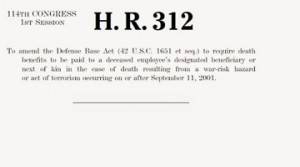
Last month, Representative Stephen Lynch reintroduced a proposed amendment to the Defense Base Act (H.R. 312). This is a re-introduction of an amendment (H.R. 5721) he proposed in late 2014 to “remove a significant penalty in federal law that currently prohibits the families of overseas federal contractors who are killed in the line of duty from receiving full death benefits if the deceased employee is unmarried with no children or other dependents.” Ultimately, Rep. Lynch’s amendment appears destined to fail. The Reason for H.R. 5721, and now H.R. 312: Representative Lynch proposed H.R. 5721, the Overseas Security Personnel Fairness Act, to address an issue that arose from the September 2012 terrorist attack on the U.S. Consulate in Benghazi, Libya. Glen Doherty, a security contractor and former Navy SEAL, was killed during the attack. He was unmarried, with neither children nor other dependents. Yet, he had activated a mandatory Defense Base Act insurance policy before deploying toRead more
- « Previous Page
- 1
- …
- 15
- 16
- 17
- 18
- 19
- …
- 39
- Next Page »